Workflow inspiration
Best AI Builder Examples That Show Real Use
The best ai builder examples are not abstract demos. They show where an idea enters an existing workflow, what changes, and what a useful handoff looks like.

- ai builder examples free Review practical examples focused on accessible starting points and lightweight experimentation.
- ai builder website See how an AI builder can support website concepts, page structure, and implementation handoffs.
- ai builder prompts Find prompt patterns that turn broad product ideas into clearer, more actionable requests.
- ai builder tutorial Follow a structured path from the first request to a reviewable result.
the audience's existing pipeline
Useful examples begin with work people already understand: a brief, a design direction, a feature request, or a technical question.
-
1
Start with the current brief
Bring the request, constraint, or rough idea that already exists in your team’s workflow. The goal is to improve the next step, not replace every step.
-
2
Shape the desired result
Describe the audience, purpose, structure, and boundaries. Specific context produces a more useful starting point than a vague request for something impressive.
-
3
Review and route the output
Treat the result as a draft or handoff artifact. A product, design, marketing, or engineering owner checks it before it enters production work.
where we slot in
An AI builder is most valuable between intent and execution: it helps make an early direction concrete enough for people to inspect, revise, and pass along.
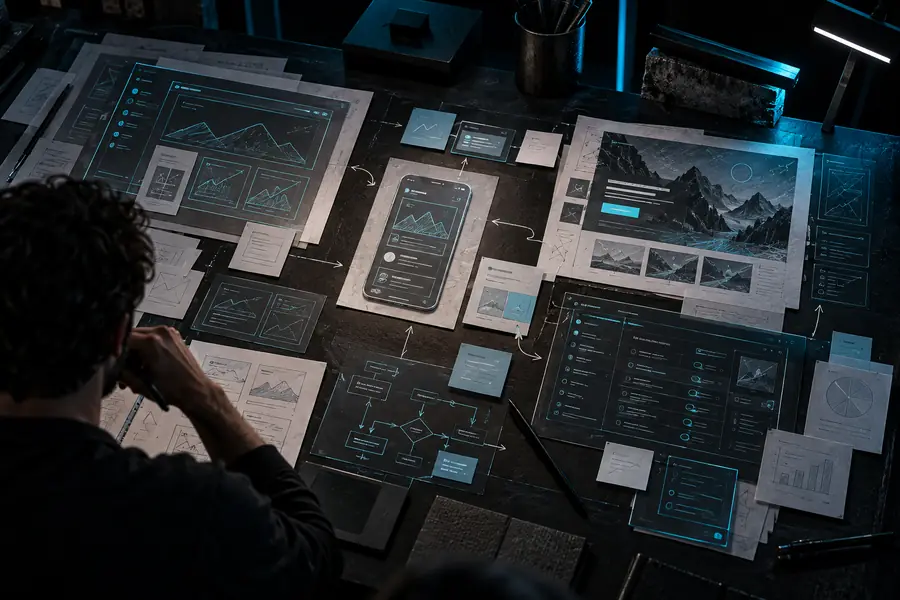
The output still needs human review before production use.
Loose starting pointReviewable working draftbefore/after
Strong examples also make the boundaries visible. These tools can accelerate an early workflow, but they do not remove judgment, ownership, or validation.
It cannot know your hidden requirements
An AI builder only sees the context you provide. Internal rules, edge cases, dependencies, and stakeholder preferences may be missing.
What to do instead
Add acceptance criteria, constraints, examples, and known failure cases before asking for a refined result.
It cannot approve production work
A generated draft may look complete while still needing accessibility, security, legal, performance, or technical review.
What to do instead
Assign a human owner to test the result and approve the handoff.
It cannot replace specialist judgment
A useful prototype is not the same as a final architecture, brand system, data model, or operational process.
What to do instead
Use the output to focus specialists on decisions and corrections rather than starting from a blank page.
It cannot guarantee the first attempt is right
Ambiguous prompts and incomplete inputs often produce a plausible but unsuitable direction.
What to do instead
Iterate with targeted feedback and compare each revision against the original goal.
deliverable spec
A good example is specific about what enters the workflow and what leaves it. This comparison separates a useful working draft from an overclaimed finished product.
| Unstructured request | Useful AI builder handoff | |
|---|---|---|
| Starting input | A broad idea with little context | A brief with audience, goal, constraints, and references |
| Primary purpose | Explore possibilities | Create a concrete draft for review |
| Expected output | An interesting but undefined result | A structured concept, draft, or implementation direction |
| Review owner | Unclear | A named product, design, marketing, or engineering owner |
| Next action | Start over or interpret manually | Revise, validate, and route to the next workflow stage |
| Success test | It looks convincing | It meets stated requirements and survives human review |
Use the pattern that fits your workflow: start with a real brief, describe the intended deliverable, and keep a reviewer responsible for the final decision.
Turn a strong example into your next draft
- Start from a concrete use case
- Keep requirements visible
- Review before handoff
scenario FAQ
The strongest examples show a clear workflow before and after the tool is introduced. Product concepts, marketing pages, design directions, and engineering drafts are useful because each has a recognizable input, review step, and deliverable.
A useful example explains the starting brief, the intended audience, the output, and the decision that follows. It should show where human review remains necessary instead of presenting an unverified result as finished work.
Yes, they can support early exploration, drafting, and handoff preparation when the team supplies enough context. The resulting work should still be checked against technical, brand, accessibility, security, and business requirements.
Look for a specific problem, a defined deliverable, and a visible route to review. Prefer examples that explain what changed in the workflow and what the tool could not decide on its own.